


Choosing between a king versus a queen mattress might seem straightforward, but there’s more to consider than size alone. Multiple size variations, room dimensions, and personal sleep preferences all come into play. Here’s what to understand about the difference between king and queen beds, and how to feel confident about choosing the best size for you.
Queen vs King Mattress: The Basics
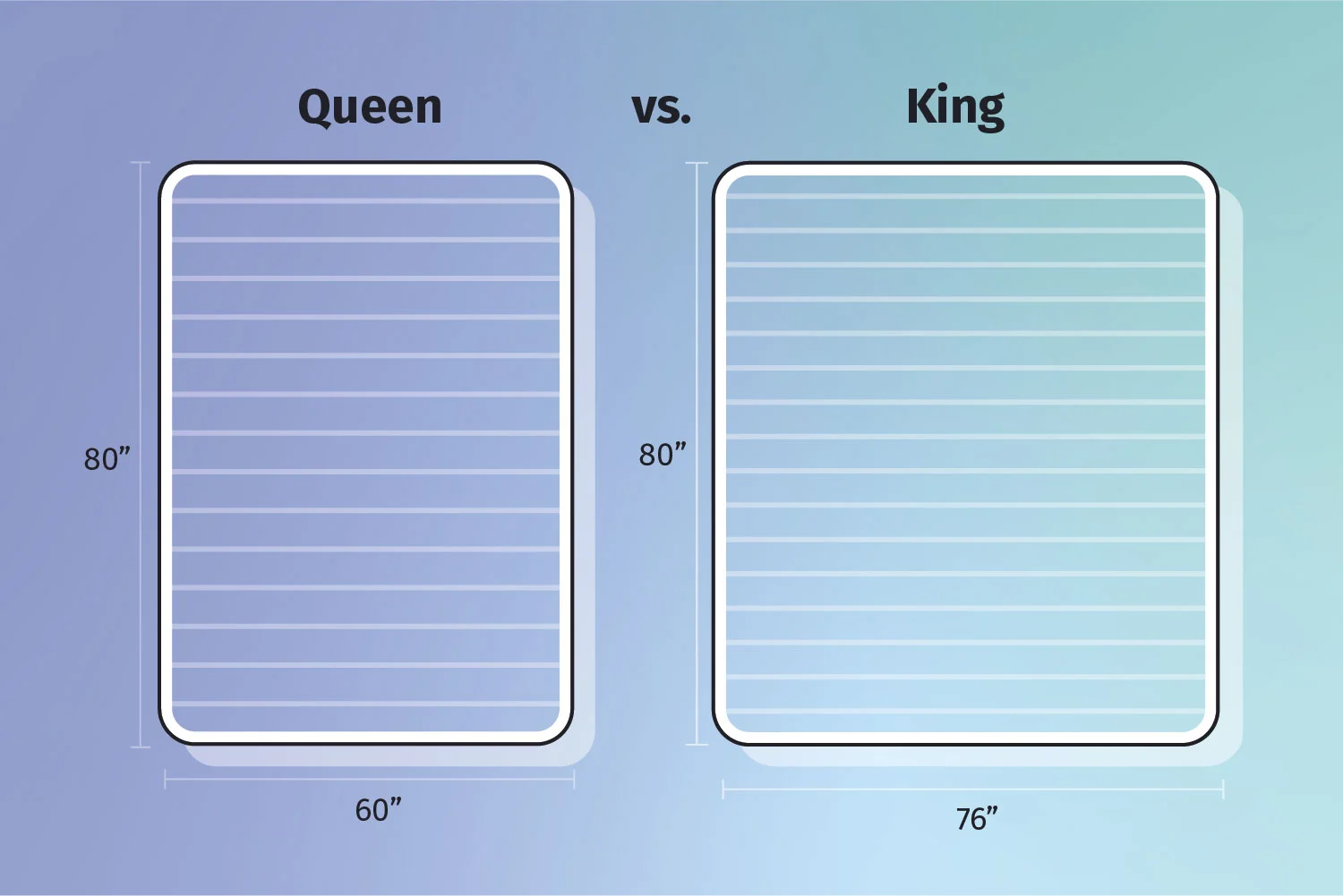
The most obvious difference between queen and king beds is the size. While they share the same length at 80”, a standard king bed is quite a bit wider — 76” compared to 60” for a queen.
| Width | Length | Width per person | |
| Queen | 60” | 80” | 30” |
| Standard (Eastern) King | 76” | 80” | 38” |
Who Is A Queen Bed Ideal For?
A queen mattress is 5” longer and 7” wider than a full-size mattress. Queen beds can accommodate individual sleepers who want more space and couples who prefer sleeping closer together, which is why it’s the most popular mattress size. Bed partners can enjoy roughly 30” of space on each side of the mattress.
The best queen beds for couples offer strong edge support to maximize sleep space. If you and your partner are looking for a queen-sized bed that offers excellent edge support and motion isolation, check out the Nolah Evolution Hybrid.
A queen can also be the best mattress for combination sleepers. It offers more space for changing positions at night without getting too close to the edge.
The queen bed’s smaller footprint also makes it a good choice for smaller master bedrooms or as a guest bedroom mattress. Queen-size beds pair well with bedroom furniture like nightstands and dressers, while still allowing for walking clearance — especially in midsize rooms. Their smaller size also makes them easier to move through doorways and hallways.
If you think a queen-size mattress is the right fit for you, check out the Nectar Classic Memory Foam mattress, Mattress Clarity’s choice for the best queen bed.
Who Is A King Bed Ideal For?
King mattresses are 16” wider than queen mattresses, so they’re ideal for personal sleep space. The extra elbow room makes king beds the best mattresses for couples. A king is the equivalent of two twin XL beds together on the same frame (which is actually considered a split king), giving both partners a roomy 38” of side-to-side space. Combination sleepers who share the bed often benefit from king-size beds, simply because there’s more room to reposition.

The extra room makes king-size beds a good choice if you’re co-sleeping with children or if you have a pet who routinely hops into bed with you. It limits crowding and sleep disturbances for everyone.
With shared king beds, motion isolation is a key feature to keep nighttime disruptions to a minimum. The Nectar Luxe Mattress, one of our picks for the best king mattresses, is also at the head of the class for best motion isolation.
King mattresses are ideal for spacious master bedrooms, but their wider footprint means they can overwhelm smaller spaces. King beds usually need a bigger bedroom to avoid feeling cramped.
The Nectar Classic Memory Foam was also our pick for the best king-size mattress, but the Helix Midnight is another standout that is a great choice for couples.
Types of King and Queen Beds
There are quite a few options for king and queen beds. Some are single mattresses, but split queens and split kings are actually two separate beds that share the same frame. Below, take a look at king vs queen mattress dimensions.
| Mattress Size | Width | Length | Best For |
| Standard Queen | 60” | 80” | Individuals or couples who like sleeping closer together |
| Olympic Queen | 66” | 80” | Couples who want extra width without upgrading to a king |
| California Queen | 60” | 84” | Waterbeds |
| Split Queen | 30” (each half) | 80” | Couples with different firmness preferences |
| Standard (Eastern) King | 76” | 80” | Couples who want to maximize personal sleep space |
| California (Western) King | 72” | 84” | Taller sleepers with narrower rooms |
| Split King | 39” (each half) | 80” | Couples with different firmness preferences |
| Split California King | 36” (each half) | 84” | Taller couples with different firmness preferences |
You Might Choose A Queen Bed If …
- You have a smaller bedroom. A queen bed means more room for bedroom furniture, but the trade-off is less personal space in bed.
- You like sleeping close to a partner. With 30″ of mattress surface for each bed partner, sharing a queen bed is a much cozier sleeping experience.
- You sleep along but want extra space. Solo sleepers often appreciate having more room to stretch out.
- You’re on a tighter budget. Queen mattresses are significantly cheaper than their king size counterparts. Not only will you save on the bed itself, queen-size frames, mattress protectors, bed sheets, and even pillows are less expensive. (You can get away with smaller pillows on a queen bed.)
- You move or rearrange furniture regularly. A queen mattress is easier to reposition if you like to refresh your bedroom layout, and it’s easier to move through doorways, hallways, and stairwells.
You Might Choose A King Bed If …
- You who have a big bedroom. King-sized beds tend to work best in larger master bedrooms that offer plenty of space to avoid feeling cramped.
- You share the bed with a partner or pet. A king bed gives you more room to spread out without affecting comfort.
- You’re a light sleeper or easily disturbed. The extra width in a king bed can help minimize sleep disruptions from a bed partner, especially when you choose a model with strong motion isolation.
- You value personal sleep space. While it comes down to personal preference, many couples opt for a king bed over a queen simply for the extra space
- You’re working with a bigger budget. King beds are the most expensive models, and you’ll need to spend more money for accessories like bed frames, pillows, and sheets.
- You want a more luxurious aesthetic. King beds have a more elevated, hotel-style mattress look and feel.
Other Things To Consider
A little planning goes a long way to avoid getting your new mattress into the bedroom, only to realize it doesn’t actually fit. Here’s how to zero in on the best mattress size for you, your bedroom, and your needs.

- Measure the space and leave room for movement. When comparing the king vs queen mattress size, think beyond the actual mattress footprint itself. Not only does the bed need to fit the space, but you’ll also need room to move around comfortably. Allowing for 30” of space around the bed is a good rule of thumb to avoid making things feel tight.
- Measure relevant doorways and staircases. Before you can get it to your bedroom, you need to get the mattress through the front door, up the stairs, in the elevator, or down the hall. Plan accordingly, and consider where you might need help with moving the mattress. A queen may be smaller than a king, but it can still be tricky to maneuver on your own.
- Consider accessories for the new mattress. If you’re upgrading to a king from a queen or a queen from a full, remember to factor in a new bed frame, foundation, and bedding. Those costs are best added to your budget when you’re shopping to avoid winding up with a beautiful new mattress and pillows or a comforter that is far too small.
Bottom Line
Choosing between a king and queen mattress really comes down to personal considerations. Factoring in your budget, bedroom size, sleep partners, and sleep habits can steer you toward the most appropriate bed size. Once you’ve settled that, focus on choosing a mattress that accommodates your body weight, sleep position, and overall comfort needs.