


Why take the time to learn about sleep positions? Here’s a good reason: At some point in their lives, approximately 80% of adults will experience back pain. And in many cases, that pain will be caused (or worsened) by their sleep position. Taking the time to learn about sleep posture now could spare you from aches and pains down the road.
The way we sleep can also impact the quality of our breathing, worsen or improve health conditions (such as sleep apnea and acid reflux), and affect our chances of obtaining quality sleep. Furthermore, without quality sleep, our everyday energy and stress levels can be significantly affected.
Even though changing your sleep position could positively impact sleep and overall well-being, many people are attached to their preferred position(s). Research suggests side sleeping is the most popular sleep position, followed closely by back sleeping. (Side sleeping is especially common among older adults, women, and people with a higher body mass index.) Stomach sleeping comes in a distant third.
While it’s suggested that people can change positions 10 to 40 times each night, we usually return to a default position. During the night, this choice is often unconscious. But by making more intentional choices about our sleep styles, we can set ourselves up for healthier sleep postures that support overall well-being.
Editor’s Note: The information provided in this article should not be considered a substitute for medical advice. Please consult a medical professional if you have personal health-related questions.
Positions and Drawbacks
As a general rule, back sleeping is thought to be the best sleeping position for spinal alignment, and its benefits don’t stop there. But that doesn’t mean every person in the universe is able to simply switch to sleeping on their back.
| Position | Best For | Drawbacks |
| Side | Most people | Shoulder pressure, knee pressure |
| Back | Spinal alignment | Snoring, apnea |
| Stomach | Some snorers | Neck strain, hip pain |
Why Your Sleeping Position Matters
Our chosen sleep position(s) can affect a variety of health conditions, exacerbate or alleviate pain, and significantly impact our sleep quality. In turn, sleep quality (or lack thereof) affects both our sleeping and our waking lives, with major ramifications for physical and mental well-being.
Spinal Alignment
Maintaining proper posture and spinal alignment while sleeping is critical to achieving healthier sleep and reducing back or hip pain. Back sleeping is often considered much better than side or stomach sleeping because your spine is most easily aligned in this position when resting on the right mattress.
However, it’s important to practice proactive, mindful approaches to sleeping on your side or back, too, to ensure your spine stays as neutral as possible in both positions. A big part of this is being posture-aware as you fall asleep, and ensuring your mattress type supports your spine based on how you rest on it.
Breathing and Airflow
Your sleeping position can affect your breathing at night, either worsening or easing the effects of sleep apnea (shortness of breath, sudden awakenings, etc.).
For example, side sleeping can help your airways stay open, which can minimize snoring and ease sleep apnea. In fact, a 2014 study found that people with obstructive sleep apnea (OSA) who slept on their left side reduced or eliminated breathing complications during sleep. On the other hand, back sleeping can exacerbate snoring and sleep apnea symptoms because gravity destabilizes the upper airway, making it harder to breathe fully and without obstruction. Many snorers find that their symptoms go away when they switch to sleeping on their side.
Pressure Relief
There isn’t really a “best” position for pressure relief. Experiencing high-quality pressure relief when you sleep correlates more with how well you’re supported in the sleeping position you practice most.
In some ways, back sleeping could be the easiest position to accommodate and offer pressure relief because your weight is evenly distributed, making spinal alignment the easiest to support. But regardless of your sleeping position, matching a mattress’s firmness and construction to how you sleep and your size is the best way to achieve optimal pressure relief in your primary sleeping position.
Digestive Health
Your sleeping position can also affect your digestive health. For example, stomach sleeping is generally seen as the worst position for digestive health, as it compresses your digestive organs and can worsen acid reflux and bloating. Furthermore, many consider the left-side sleeping position the best because gravity naturally helps stomach contents and gas move downward.
Side Sleeping
Research suggests side sleeping is the most popular sleep position. While it might not offer the same spinal health benefits as sleeping on your back, there are still several reasons to embrace this position. Let’s take a look at the benefits of side sleeping, who should avoid this position, and modifications and tips to optimize your sleep quality while snoozing on your side.
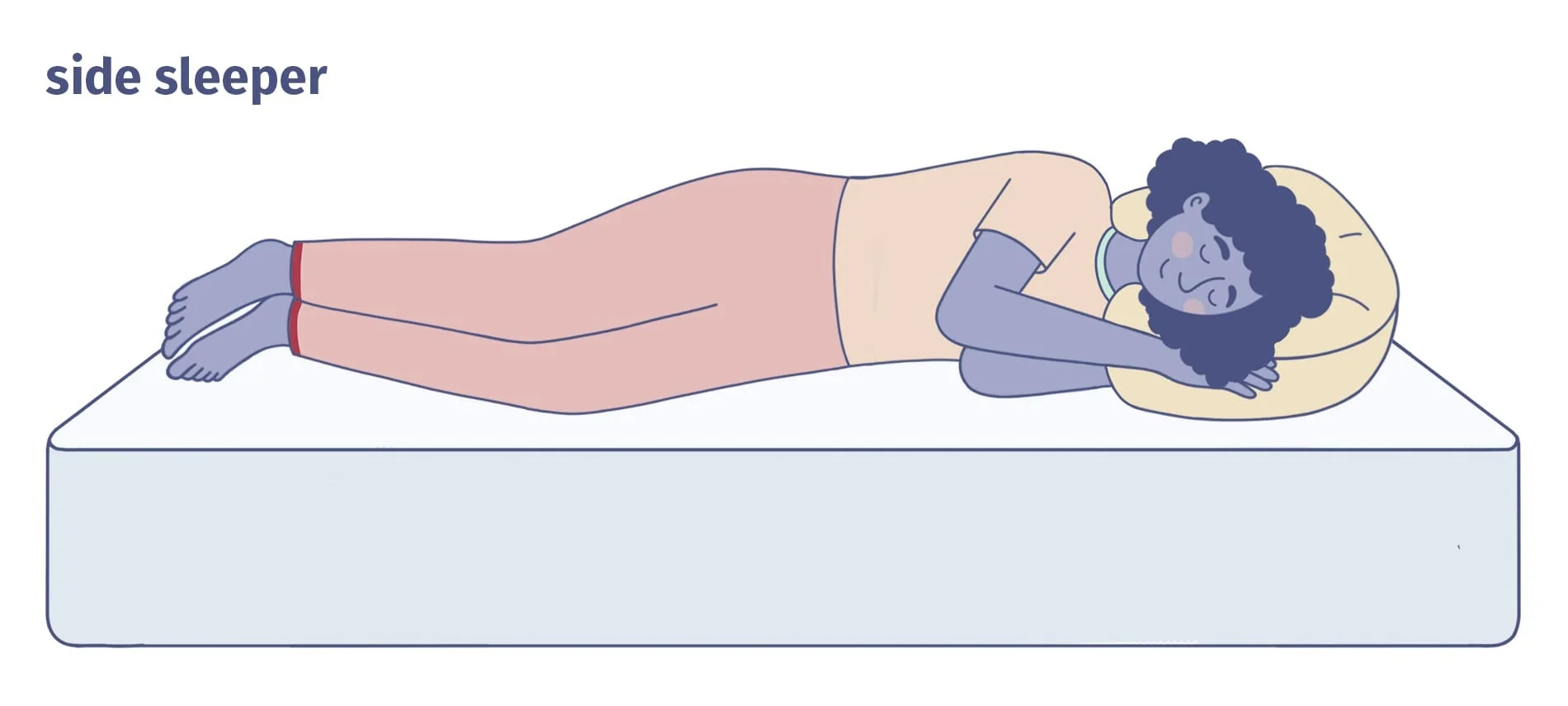
Benefits of Side Sleeping
- Side sleeping is the safest sleep position for pregnant people. As noted above, the general consensus is that pregnant people fare best when sleeping on their side. This position promotes circulation to the adult and fetus and reduces strain on the organs.
- Side sleeping can reduce symptoms of GERD and acid reflux. Sleeping on the left side can ease symptoms of acid reflux or heartburn. That’s because it’s harder for stomach acids to rise up into the esophagus when your body is in this position. Note that sleeping on the right side can actually exacerbate symptoms.
- Side sleeping could reduce lower back pain. One 2017 study found that side sleeping could ease backaches and pains and lessen stiffness upon waking.
- Side sleeping can minimize snoring and sleep apnea symptoms. Side sleeping can help your airways stay open, which can minimize snoring and ease sleep apnea. In fact, a 2014 study found that people with obstructive sleep apnea (OSA) who slept on their left sides reduced or eliminated breathing complications during sleep.
Potential Drawbacks of Side Sleeping
- People who regularly experience shoulder pain and/or are prone to shoulder injuries might want to avoid side sleeping. This position is notorious for putting pressure on the shoulder, which can worsen aches and pains. It can also provoke a “pins and needles” sensation; not only is this uncomfortable, but it’s a sign that circulation is diminished.
- There’s some evidence that sleeping on the right side can increase pressure on the heart, so this position isn’t advised for anyone with a heart condition.
- Side sleeping puts half your face in contact with a pillow or mattress, which can create friction between your skin and bedding and expose your skin to the sweat and oils that we shed into our bedding. This could provoke breakouts and lead to wrinkles over time.
Left Side vs Right Side Sleeping
Because of your organ’s anatomy, sleeping on your left side is considered better than on your right. Sleeping on your right side can worsen heartburn or acid reflux and can reduce blood flow through the body.
Best Mattress for Side Sleepers
Side sleepers generally prefer softer mattresses with enhanced pressure relief. How soft will depend on a person’s body size, but softer mattresses are a go-to for side sleepers.
Sleeping on your side can place more tension on the neck, shoulders, and hips, so the mattress needs to offset that pressure. For that reason, side sleepers usually require a mattress that offers effective cushioning around their hips and shoulders without disrupting their spinal alignment. This reduces pain in those areas and also helps ensure the spine stays aligned.
I suggest taking a look at our top mattress picks for side sleepers of 2026 review.
Best Pillow Setup for Side Sleepers
The pillow under your head should be tall enough that your neck stays aligned with the rest of your spine. If it’s too flat, it can cause cervical misalignment or neck strain, which could lead to neck pain and/or tension headaches.
There are pillows that work better for side sleepers or are even made specifically for them. Take a look at our top pillows for side sleepers review for 2026.
Back Sleeping
As I’ve mentioned, back sleeping is thought to be the best sleeping position for spinal alignment, and its benefits don’t stop there. Let’s take a look at the benefits and potential downsides of this sleeping position.
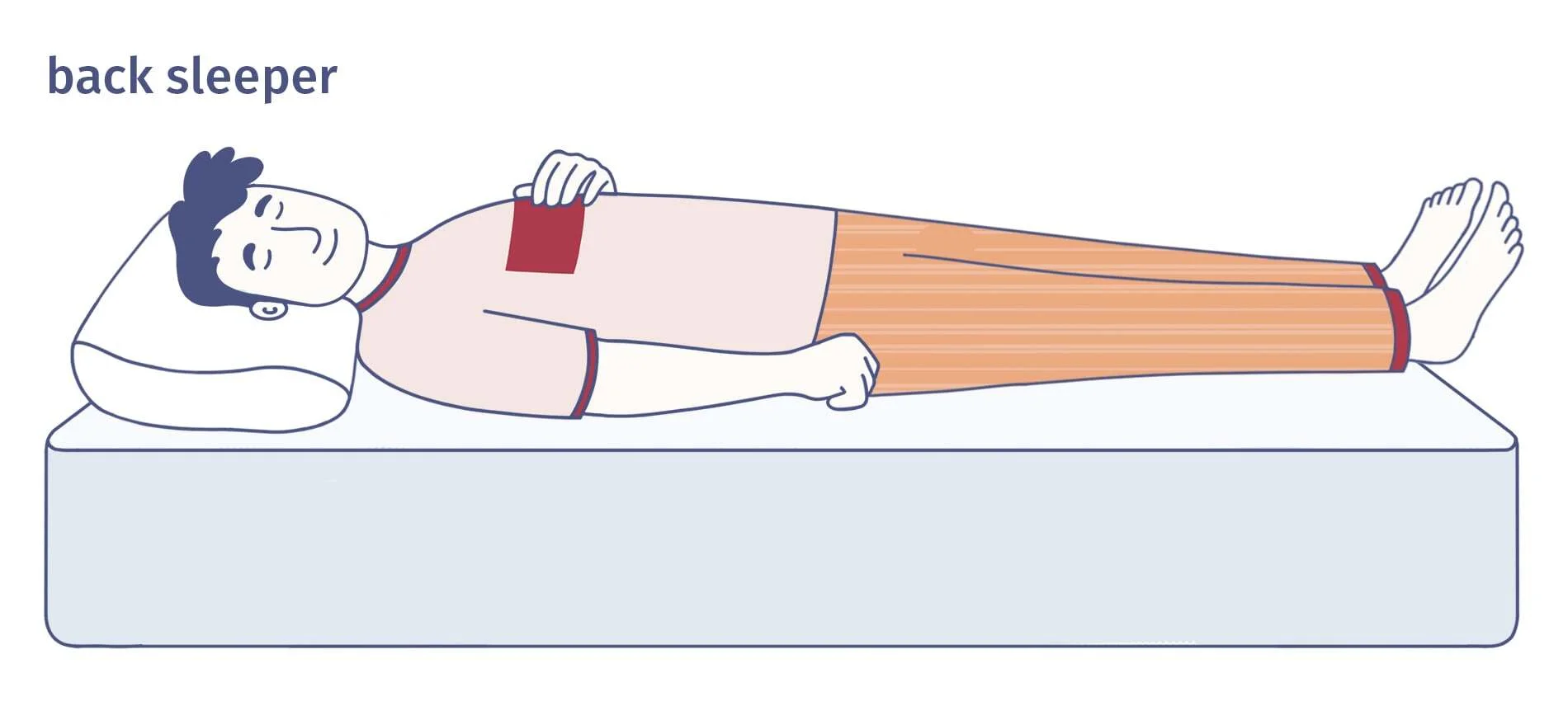
Benefits of Back Sleeping
- Back sleeping generally does the best job of maintaining healthy spinal alignment. Maintaining an aligned posture while sleeping allows you to breathe at full capacity and minimizes the chances of developing aches and pains.
- So long as you’re sleeping on a supportive mattress, lying on your back helps keep the hips elevated and aligned with the spine. This reduces pressure on the spine and supports healthy posture. Additionally, this position doesn’t put any pressure on the sides of the hips, which are common hot spots for people with hip pain.
- Back sleeping eliminates friction between facial skin and the pillowcase. This reduces wear and tear on the skin and potentially minimizes your skin’s exposure to pore-clogging facial oils and sweat, all of which can support a dewy complexion or prevent facial wrinkles.
Potential Drawbacks of Back Sleeping
- Back sleeping could aggravate acid reflux and GERD (gastroesophageal reflux disease) symptoms because this position allows stomach acid to travel upward more easily without the help of gravity to keep it down. Put simply, lying flat, or being horizontal when sleeping on your back, may make acid reflux more likely to flare up.
- Back sleeping can worsen snoring and sleep apnea because gravity destabilizes the upper airway, making it harder to breathe without obstruction. Many snorers are often pushed to their side by their partner because snoring may go away when they switch to sleeping on their side, as it’s easier to breathe.
- In general, it’s recommended that pregnant people avoid back sleeping and sleep on their side instead. Side sleeping best supports circulation and reduces pressure on the veins and internal organs (especially on your left side). In contrast, back sleeping while pregnant could cause backaches, trouble breathing, digestive issues, and other concerns.
Best Mattress for Back Sleepers
In general, back sleepers prefer medium-firm beds because they provide spinal support combined with a touch of pressure relief. A mattress that is too soft might not offer enough support to keep the hips and spine aligned, while a mattress that’s too firm could create pressure points around the shoulders or hips. Be like Goldilocks and search for a mattress that’s right in the middle.
You can also take a look at our 2026 roundup of the best mattresses for back sleepers.
Best Pillow Setup for Back Sleepers
Opt for a memory foam or latex pillow with some “give” to support the neck’s natural curve. Make sure the pillow rests at a height that keeps your neck aligned with the rest of your spine.
Consider checking out our top picks for the best pillow for back sleepers today.
Stomach Sleeping
In general, experts discourage sleeping on the stomach. This position simply doesn’t offer much for spinal health, and it could do more harm than good.
Stomach sleeping often causes back pain because it’s hard to keep the hips aligned with the spine all night. And for stomach sleepers who sleep with their head turned to one side, this position is often a recipe for neck pain. The same is true for stomach sleepers who use a lofty pillow that raises their neck above the rest of the spine.
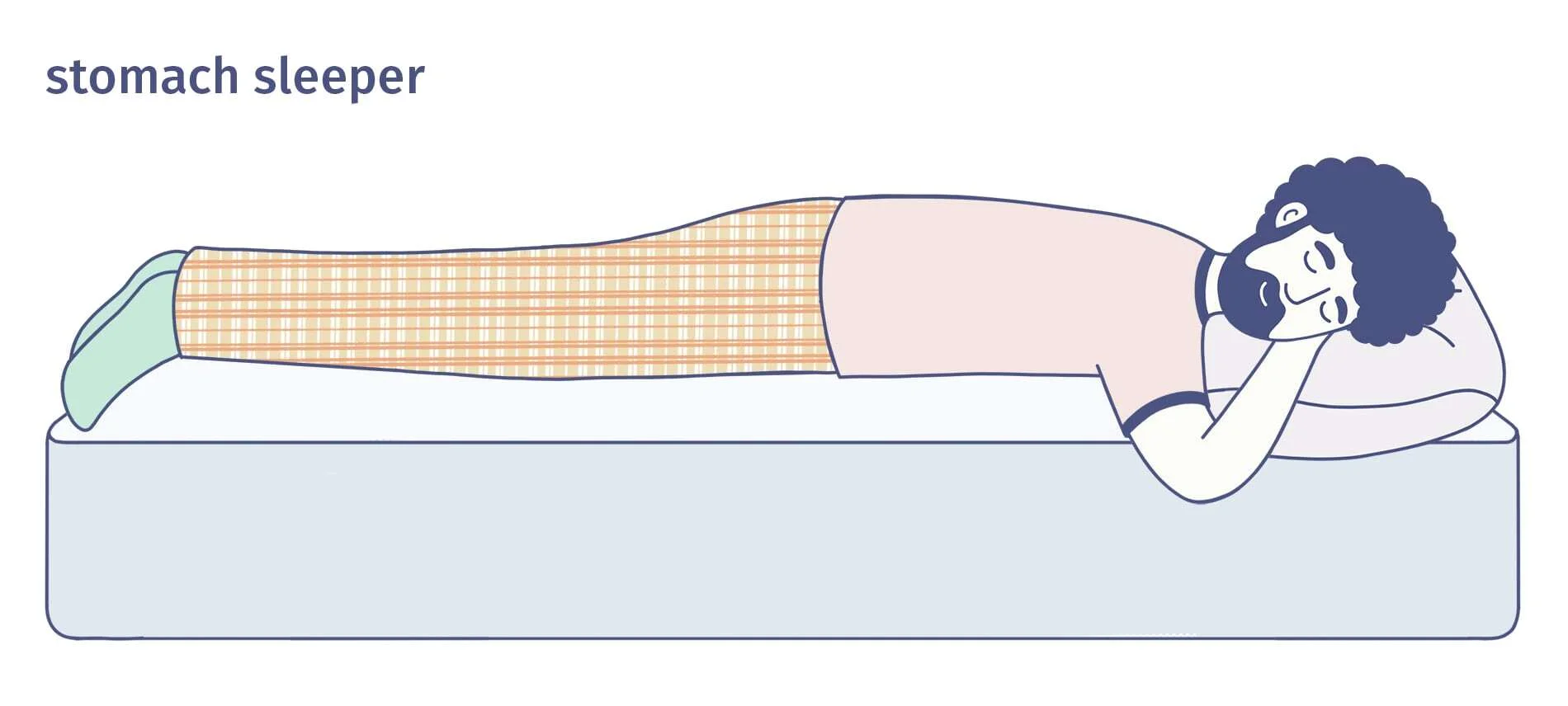
Benefits of Stomach Sleeping
One study found stomach sleeping to be the worst for hip pain, lumbar pain, and maintaining spinal alignment. Because of this, I’d encourage sleepers to try to switch to their back or sides. However, there are ways to minimize the consequences of stomach sleeping, such as using a firmer mattress or a thin pillow under your hips. I’ll go into more detail about this below.
Risks of Stomach Sleeping
If your mattress is too soft or you are not supported correctly, inflammation in your hips and lower back while sleeping on your stomach is a significant risk and quite a common experience for stomach sleepers. Also, compressing your neck to one side all night can cause neck pain, cervical spine strain, and shoulder pain.
Additionally, because you are compressing your organs through the night, stomach sleepers may experience digestive issues more easily than side or back sleepers.
How to Reduce Neck, Shoulder, Hip, and Lumbar Pain when Stomach Sleeping
- Tuck a small pillow under the lower abdomen and/or pelvis to keep the hips elevated and aligned with the spine. This supports the natural curve of the lower back and can reduce back strain at night.
- If you’re pregnant, consider using a donut-shaped pillow. As the name implies, donut-shaped pillows are circular pillows with a hole in the middle. This hole creates space for a pregnant belly, while the perimeter of the “donut” creates extra support that can make stomach sleeping more comfortable. Note that stomach sleeping is strongly discouraged for pregnant people closer to the end of their pregnancy.
- Try to avoid hiking one leg higher than the other, as this can twist the hips and lower back. Over time, this could create aches and pains.
- If you’re going to use a pillow, consider using a low-loft or flat pillow to prevent disrupting cervical spine alignment more than the position already does.
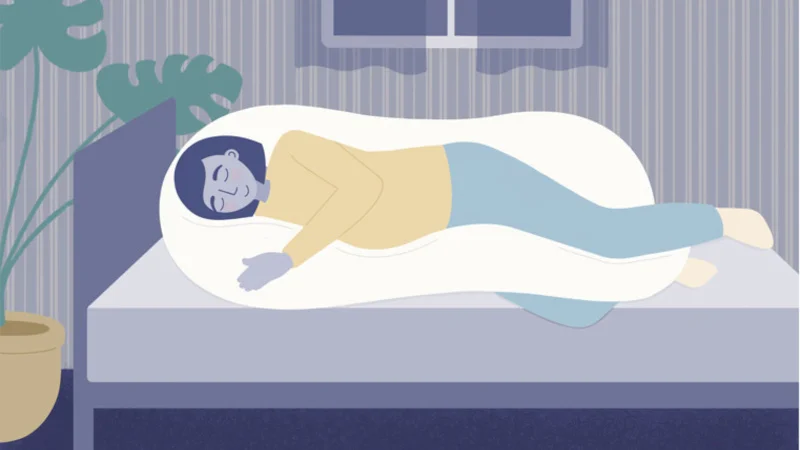
- Even if you’re committed to sleeping on your stomach sometimes, it’s a good idea to experiment with back and side sleeping whenever possible to give your spine a break from stomach sleeping. Try side sleeping with a full-body pillow so you can’t roll onto your stomach in your sleep. Similarly, if you want to experiment with back sleeping, try placing pillows on either side of your body to make it harder to roll onto your stomach.
- Make sure you have a mattress with an appropriate firmness.
Best Mattress for Stomach Sleepers
Stomach sleepers should look for a mattress on the firmer side. A firmer mattress offers good spinal support for stomach sleepers because it helps prevent the hips from sinking too far into the bed and tugging the spine out of alignment. In general, stomach sleepers require a more supportive mattress than back or side sleepers.
Best Sleeping Positions for Different Health Conditions
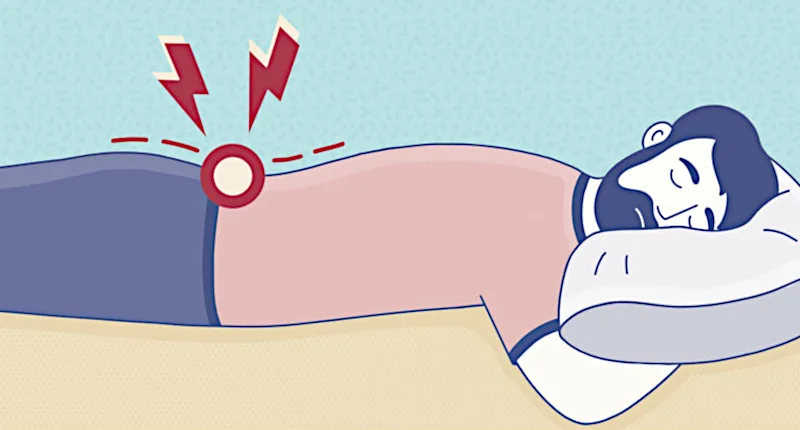
Best Sleeping Position for Back Pain
The best sleeping position for back pain is back sleeping. As long as you’re on the appropriate mattress type, lying on your back helps keep your hips elevated and aligned with the spine. This reduces pressure on the lower back and supports healthy posture.
Best Sleeping Position for Neck Pain
Sleeping on your back (or the supine position) is widely considered the best sleeping position for neck pain, as it helps keep your cervical spine aligned and doesn’t strain your neck muscles as much as stomach sleeping (prone sleeping).
One study found that sleeping on your back, specifically with your arms at your side, is the optimal sleeping position to prevent neck and shoulder pain.
Best Sleeping Position for Shoulder Pain
Back sleeping is recommended for shoulder pain more than side or stomach sleeping, as supported by a 2017 study. Another study found that side-sleeping can, in some cases, worsen shoulder injuries.
Best Sleeping Position for Hip Pain
Back sleeping with proper posture support and arms at your sides is the best sleeping position for hip pain. In contrast, stomach sleeping is considered the worst for hip pain, and it’s recommended to use a flat pillow under your hips to help prevent hip pain buildup when stomach sleeping.
Best Sleeping Position for Acid Reflux
According to one study, sleeping on your left side may be the best sleeping position to reduce the effects of acid reflux. Furthermore, Harvard Health also suggests that sleeping on your left side is best for heartburn.
Best Sleeping Position for Sleep Apnea
Side sleeping is considered the best sleeping position for sleep apnea. One clinical trial found that back sleepers were twice as likely to experience sleep apnea-related issues as side sleepers.
Best Sleeping Position for Snoring
Side sleeping is also considered the best position to reduce snoring. For example, one 2003 study found that side sleepers snored less than back sleepers. As many couples likely know, when there is a snorer in the bed, rolling them onto their side usually helps reduce the volume.
Best Sleeping Position During Pregnancy
According to the American Pregnancy Association’s official site, “The best sleep position during pregnancy is ‘SOS’ (sleep on side) because it provides the best circulation for you and your baby.” The site also adds the benefit of sleeping specifically on your left side when pregnant, saying “Sleeping on your left side will increase the amount of blood and nutrients that reach the placenta and your baby.”
How to Change Your Sleeping Position
As I’ve mentioned, people can change positions 10 to 40 times each night (with insomnia, this may be even worse). During the night, this choice is often unconscious. But by making more active efforts to prepare for sleep while awake, we can potentially enhance our overall sleep hygiene, heart health, and well-being.
Using Pillows
Try side sleeping with a full body pillow so you aren’t able to roll onto your stomach in your sleep. Similarly, if you want to experiment with back sleeping, try placing supportive pillows on either side of your body so it’s more difficult to flip over to your stomach.
Training Yourself to Stay in Position
In addition to using extra pillows to create soft barriers that prevent you from switching positions while you sleep, you can also practice active posture awareness before you fall asleep. For example, if you’re sleeping on your back, try to keep your arms by your sides as you drift off. Or, if you sleep on your side, put a pillow between your knees, try to keep your neck aligned with your spine, with your arms gently placed in front of your face, and use a supportive mattress that keeps your spine aligned without letting you sink too much into it.
Furthermore, whether on your back or side, try to always create a friendly sleep environment (quiet, no screens, cool temperature, no disruptive light, etc.). As Dr. Shelby Harris, a licensed clinical psychologist, says, “Creating a sleep-inducing environment includes keeping the room dark and cool at night. You can do this by hanging up blackout curtains to keep out unwanted light at night and turning down the thermostat to anywhere between 60 and 69 degrees Fahrenheit while you sleep, with most people falling around 67 degrees.”
Choosing the Right Mattress for Your Sleep Position
Your sleeping position and size determine which mattress is best for you. Consider taking our mattress quiz to help you find the right mattress for your unique needs.
Side Sleepers
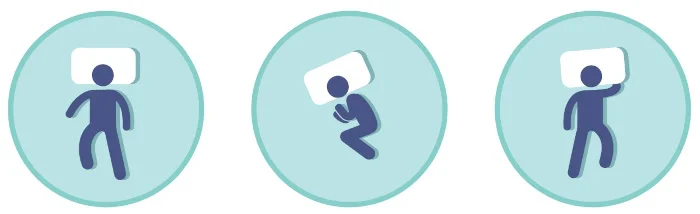
Side sleepers will generally prefer a softer (4-6/10) mattress firmness that cushions them and counteracts the weight shifting from one side to the other when they sleep. Memory foam beds are often a great choice for side sleepers.
Back Sleepers
Back sleepers will find a medium-firm (6.5/10) mattress the best firmness choice. However, this can vary depending on their weight. Hybrid mattresses are often great picks for back sleepers.
Stomach Sleepers
Stomach sleepers will want a firmer mattress (7/10 and above) to help keep their hips and shoulders aligned. Latex mattresses and innerspring mattresses are great choices for stomach sleepers.
Combination Sleepers
Combination sleepers will enjoy the industry-standard 6.5/10 medium-firmness because it’s considered one of the most accessible firmness levels for different sleeper types. Furthermore, hybrid mattresses work great for combination sleepers due to their versatility.
Frequently Asked Questions
What is the healthiest sleeping position?
Back sleeping is considered the healthiest sleeping position to prevent various joint and muscle pains. However, side sleeping (specifically on your left side) is considered the best sleep position to reduce snoring and acid reflux.
Is side sleeping better than back sleeping?
For pregnant women, people with heartburn and acid reflux, or sleepers struggling with sleep apnea or snoring, side-sleeping is considered the best position. However, sleeping on your back is the best position to prevent various types of chronic pain.
Why is stomach sleeping bad?
Stomach sleeping is often considered the least favorable or a “bad” sleeping position because it easily disrupts your spine’s alignment, creates a great deal of tension in your neck and hips, and compresses your organs while you sleep.
What sleeping position helps with back pain?
Back sleeping is the most optimal position to help with back pain. The neutral position it provides helps to keep your spine more aligned.
Citations
- The Ohio State University Wexner Medical Center. (2018, October 4). What sleep positions are best for your back? https://wexnermedical.osu.edu/our-stories/what-sleep-positions-are-best-for-your-back
- Skarpsno ES, Mork PJ, Nilsen TIL, Holtermann A. Sleep positions and nocturnal body movements based on free-living accelerometer recordings: association with demographics, lifestyle, and insomnia symptoms. Nat Sci Sleep. 2017 Nov 1;9:267-275. doi: 10.2147/NSS.S145777. PMID: 29138608; PMCID: PMC5677378.
- National Heart, Lung, and Blood Institute (2025, January): What is Sleep Apnea?
- Saini Y, Rai A, Sen S. Relationship Between Sleep Posture and Low Back Pain: A Systematic Review. Musculoskeletal Care. 2025 Jun;23(2):e70114. doi: 10.1002/msc.70114. PMID: 40338112.
- National Heart, Lung, and Blood Institute. (2022, March 24). Sleep Deprivation and Deficiency: What are sleep deprivation and deficiency? U.S. Department of Health and Human Services. https://www.nhlbi.nih.gov/health/sleep-deprivation
- Harvard Health Publishing. (2021, August 17). Sleep and Mental Health. Harvard Medical School. https://www.health.harvard.edu/newsletter_article/sleep-and-mental-health
- Johns Hopkins Medicine. (2025, October 6). Choosing the best sleep position. https://www.hopkinsmedicine.org/health/wellness-and-prevention/choosing-the-best-sleep-position
- Oksenberg A, Gadoth N. Are we missing a simple treatment for most adult sleep apnea patients? The avoidance of the supine sleep position. J Sleep Res. 2014 Apr;23(2):204-10. doi: 10.1111/jsr.12097. Epub 2013 Oct 10. PMID: 24118690.
- Domonell, K. (2016, March 18). What sleeping position is best for you?. https://edition.cnn.com/2016/03/18/health/sleep-positions-good-bad/index.html
- Dantas RO, Aben-Athar CG. Aspectos dos efeitos do sono no aparelho digestório [Aspects of sleep effects on the digestive tract]. Arq Gastroenterol. 2002 Jan-Mar;39(1):55-9. Portuguese. doi: 10.1590/s0004-28032002000100010. PMID: 12184167.
- Skarpsno ES, Mork PJ, Nilsen TIL, Holtermann A. Sleep positions and nocturnal body movements based on free-living accelerometer recordings: association with demographics, lifestyle, and insomnia symptoms. Nat Sci Sleep. 2017 Nov 1;9:267-275. doi: 10.2147/NSS.S145777. PMID: 29138608; PMCID: PMC5677378.
- American Pregnancy Association. (2026, April 20). Best sleeping positions while pregnant. https://americanpregnancy.org/pregnancy/sleeping-positions-while-pregnant/
- Cary D, Briffa K, McKenna L. Identifying relationships between sleep posture and non-specific spinal symptoms in adults: A scoping review. BMJ Open. 2019 Jun 28;9(6):e027633. doi: 10.1136/bmjopen-2018-027633. PMID: 31256029; PMCID: PMC6609073.
- Richards DP, Miller DL, MacDonald ED, Stewart QF, Miller SD. Rotator Cuff Tears Are Related to the Side Sleeping Position. Arthrosc Sports Med Rehabil. 2024 Feb 2;6(2):100886. doi: 10.1016/j.asmr.2024.100886. PMID: 38328528; PMCID: PMC10847686.
- Walsh, K. (2024, January 10). 3 simple steps to better sleep, according to health experts. Shape.https://www.shape.com/how-to-sleep-better-8414340
- Bell, A. (2025, July 17). The best side to sleep on for digestion and other benefits. Medical News Today .https://www.medicalnewstoday.com/articles/best-side-to-sleep-on-for-digestion
- Simadibrata DM, Lesmana E, Amangku BR, Wardoyo MP, Simadibrata M. Left lateral decubitus sleeping position is associated with improved gastroesophageal reflux disease symptoms: A systematic review and meta-analysis. World J Clin Cases. 2023 Oct 26;11(30):7329-7336. doi: 10.12998/wjcc.v11.i30.7329. PMID: 37969463; PMCID: PMC10643078.
- University of Rochester Medical Center. (2026). Good sleeping posture helps your back. https://www.urmc.rochester.edu/encyclopedia/content?ContentTypeID=1&ContentID=4460
- Khoury RM, Camacho-Lobato L, Katz PO, Mohiuddin MA, Castell DO. Influence of spontaneous sleep positions on nighttime recumbent reflux in patients with gastroesophageal reflux disease. Am J Gastroenterol. 1999 Aug;94(8):2069-73. doi: 10.1111/j.1572-0241.1999.01279.x. PMID: 10445529.
- Hospital for Special Surgery. (2020, December 10). 5 things you should know about sleep and low back pain. https://www.hss.edu/health-library/move-better/sleep-and-low-back-pain
- Cleveland Clinic. (2023, June 12). Is sleeping on your stomach bad? https://health.clevelandclinic.org/sleeping-on-stomach
- Ylinen J, Häkkinen A, Kautiainen H, Multanen J. Preferences and Avoidance of Sleeping Positions Among Patients With Chronic Low Back Pain: A Cross-Sectional Study. Cureus. 2024 May 6;16(5):e59772. doi: 10.7759/cureus.59772. PMID: 38846227; PMCID: PMC11153877.
- Lee WH, Ko MS. Effect of sleep posture on neck muscle activity. J Phys Ther Sci. 2017 Jun;29(6):1021-1024. doi: 10.1589/jpts.29.1021. Epub 2017 Jun 7. PMID: 28626314; PMCID: PMC5468189.
- Schuitenmaker JM, Kuipers T, Oude Nijhuis RAB, Schijven MP, Smout AJPM, Fockens P, Bredenoord AJ. Sleep Positional Therapy for Nocturnal Gastroesophageal Reflux: A Double-Blind, Randomized, Sham-Controlled Trial. Clin Gastroenterol Hepatol. 2022 Dec;20(12):2753-2762.e2. doi: 10.1016/j.cgh.2022.02.058. Epub 2022 Mar 14. PMID: 35301135.
- Godman, H. (2022, June 1). What’s the best sleep position to combat heartburn? Harvard Health Publishing. https://www.health.harvard.edu/diseases-and-conditions/whats-the-best-sleep-position-to-combat-heartburn
- Cartwright RD. Effect of sleep position on sleep apnea severity. Sleep. 1984;7(2):110-4. doi: 10.1093/sleep/7.2.110. PMID: 6740055.
- Nakano H, Ikeda T, Hayashi M, Ohshima E, Onizuka A. Effects of body position on snoring in apneic and nonapneic snorers. Sleep. 2003 Mar 15;26(2):169-72. doi: 10.1093/sleep/26.2.169. PMID: 12683476.